WALTHAM 6167058 Royal Pocket Watch Movement Railroad Dial 16S 17J M1888 Clock
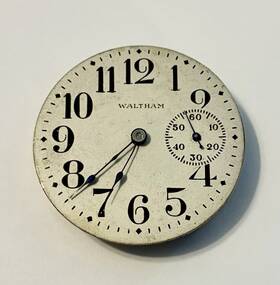
( Brand: Waltham ), ( Manufacturer Part Number: 6167058 ), ( Type: Movement ), ( Movement Type: Mechanical ), ( Country Of Origin: United States )
Review WALTHAM Royal 16s 17j Pocket Watch Movement Railroad Dial Clock Sub
The Waltham 6167058 Royal 16s Movement is a meticulously crafted, high-grade pocket watch movement that embodies the timeless elegance and precision of American horology at its finest. Originally designed for the legendary **Royal 16s** line of pocket watches, this **M1888** movement is a masterpiece of 19th-century engineering, reflecting the unparalleled craftsmanship of the **Waltham Watch Company** a pioneer in the American watchmaking industry. With its **16-jewel regulation**, this movement achieves remarkable accuracy, minimizing friction and heat within the mechanism to ensure consistent timekeeping. The **railroad dial** variant, often associated with early railroad timekeeping standards, features a bold, high-contrast design with large, easily readable numerals, making it ideal for both functional and decorative purposes.
At the heart of this movement lies a **lever escapement**, a hallmark of precision timekeeping that allows for smooth, rhythmic ticking and enhanced accuracy compared to earlier anchor escapement designs. The **16 jewels** comprising eight pallet stones and eight escape-wheel stones reduce wear on the movement s critical components, extending its longevity and maintaining its reliability over decades of use. The **M1888** designation itself is a nod to the movement s historical roots, referencing the model s introduction in the late 19th century, a time when Waltham watches were synonymous with quality and innovation.
The movement s **palladium-plated** components, including the balance wheel, hairspring, and lever, contribute to its durability while maintaining a refined, polished appearance. The **16s** designation indicates its **16-hour power reserve**, allowing the watch to remain accurate for an extended period without winding, a feature that was particularly valuable in an era before frequent winding was expected. The **railroad dial** variant is particularly striking, often featuring a **black or dark blue enamel background** with **white or gold Arabic numerals**, designed for maximum legibility whether in bright sunlight or dim lighting. This dial style was historically favored by railroad companies and travelers, as it provided clear timekeeping in varying conditions.
Beyond its functional brilliance, the Waltham 6167058 is a **collector s treasure**, prized by horology enthusiasts for its historical significance and mechanical sophistication. The movement s **hand-finished components**, including the **gilt or silver-plated bridges and plates**, add to its aesthetic appeal, making it as much a work of art as a timekeeping instrument. Whether installed in a restored **Royal 16s** pocket watch or repurposed into a modern case, this movement carries the legacy of Waltham s golden age, blending **practicality, heritage, and unmatched craftsmanship** into a single, timeless mechanism. For those who appreciate the art of watchmaking, the Waltham 6167058 is not merely a movement it is a piece of mechanical history, a testament to the precision and innovation that defined an era.
### **Pros and Cons of buying a Waltham 6167058 Royal 16s 17J M1888 Pocket Watch Movement with Railroad Dial**
#### **Pros**
1. **Historical Significance and Heritage** The Waltham 6167058 movement is a classic example of early American watchmaking, dating back to the late 19th century. It was produced by the **Waltham Watch Company**, one of the pioneers of the American watch industry, and was used in many high-quality pocket watches of the era. Owning a piece with this movement connects you to a rich mechanical tradition.
2. **Railroad Dial Design** The **railroad dial** (17J) is a distinctive and functional feature, originally used in railroad timekeeping to provide clear, easy-to-read time at a glance. This design is both nostalgic and practical, making it appealing to collectors and enthusiasts who appreciate vintage aesthetics.
3. **M1888 Movement** The **M1888** is a **16-size (16.5mm) lever-set movement**, which was a common and reliable design in the late 1800s. It features:
- A **lever escapement**, which was an improvement over the earlier fusee and vertical lever designs, offering better accuracy and efficiency.
- **Manual winding** (not self-winding), which means you ll need to wind it regularly, but this also adds to its charm and authenticity.
- **No modern complications** this is a simple yet elegant timekeeping mechanism, free from unnecessary gimmicks.
4. **Durability and Craftsmanship** Waltham movements of this era were built to last. The **16-size movement** is robust, with sturdy gears and a durable construction. While not as precise as modern quartz or automatic movements, it demonstrates the engineering skills of the time.
5. **Collectibility and Investment Potential** Vintage Waltham movements, especially those in good condition, are sought after by collectors. If preserved well, this movement could appreciate in value over time, making it a potential long-term investment.
6. **Aesthetic Appeal** The **Royal 16s** designation suggests a premium build quality, and the railroad dial adds a unique visual character. Many collectors appreciate the raw, mechanical beauty of vintage movements without modern polish.
7. **Educational Value** Owning and maintaining this movement allows you to learn about **mechanical watchmaking**, including:- How **lever escapements** work.
- The importance of **jewel bearings** (this movement likely has at least one, improving smoothness).
- The mechanics of **manual winding** and **timekeeping adjustments**.
8. **Customization Potential** Since this is a **movement-only** purchase (not a complete watch), you have the flexibility to:- Choose a **case and dial** that suits your style (e.g., vintage brass, modern minimalist, or even a DIY project).
- Experiment with **different hands, dial colors, and case designs** to create a unique timepiece.
9. **Low Maintenance (Compared to Modern Standards)** While it requires occasional winding and potential adjustments, the **lack of electronics** means fewer things can go wrong over time. Many vintage movements outlast modern ones if properly cared for.
10. **Connection to a Mechanical Tradition** In an era dominated by quartz and smartwatches, owning a **fully mechanical, manually wound** timepiece is a nod to analog craftsmanship. It encourages a slower, more deliberate relationship with time.
---
#### **Cons**
1. **No Power Reserve Indicator** Unlike modern automatic watches, this movement **does not have a power reserve display**. You must rely on **regular winding** (typically every 36 48 hours) to keep it running. Forgetting to wind it will cause the watch to stop.
2. **Limited Accuracy** Vintage lever movements like the M1888 were not designed for **high precision**. They may lose or gain a few seconds per day, depending on conditions (temperature, position, wear). If exact timekeeping is critical, this is not the best choice.
3. **Manual Winding Required** Unlike automatic watches, you **must wind it by hand** every few days. This can be seen as a nuisance by those who prefer hands-off timekeeping.
4. **Potential for Wear and Tear** Being over **130 years old**, the movement may show signs of wear, such as:- **Sluggish or uneven movement** (due to worn gears or pallet stones).
- **Jewel wear** (if the movement has only one or two jewels, friction can increase over time).
- **Oil degradation** (old lubricants can dry out, affecting smoothness).
- **Case or dial deterioration** (if the watch is not in pristine condition).
5. **No Modern Complications** This is a **simple time-only movement**. If you want features like **chronograph, moon phase, or date**, this movement cannot provide them.
6. **Limited Availability of Parts** While Waltham movements are well-documented, **finding exact replacement parts** (especially for very old movements) can be challenging. Some components may require **custom machining or restoration work**.
7. **Not Water-Resistant** Vintage pocket watch movements (and most cases from this era) are **not waterproof**. Exposure to moisture can cause rust and damage.
8. **Learning Curve for Maintenance** If you re not familiar with **watch repair**, maintaining a vintage movement can be intimidating. You may need to:
- Learn how to **wind it properly**.
- Understand **basic adjustments** (e.g., setting the time, checking for friction).
- Know when to **seek professional restoration**.
9. **Potential for Hidden Damage** If purchasing a **used movement**, there s a risk of:- **Internal rust** (common in old movements).
- **Broken or worn gears**.
- **Case or dial cracks** (if the watch was not well-preserved).
- **Previous repairs that may have compromised quality**.
10. **Not Ideal for Everyday Wear** Due to its **fragility, lack of water resistance, and manual winding**, this movement is better suited for **display or occasional wear** rather than daily use.
---
### **Conclusion**
The **Waltham 6167058 Royal 16s 17J M1888 pocket watch movement with railroad dial** is a **fascinating piece of mechanical history** that offers a unique blend of **craftsmanship, nostalgia, and educational value**. It is best suited for:
- **Collectors** who appreciate vintage watchmaking.
- **Enthusiasts** who enjoy the challenge of maintaining a manual movement.
- **DIYers** who want to build or restore a custom timepiece.
- **Those who value analog simplicity** over modern convenience.
However, it is **not ideal** for:- People who want **precise, hands-off timekeeping**.
- Those who prefer **water-resistant, automatic, or smartwatch features**.
- Individuals who dislike **regular maintenance tasks**.
If you are **passionate about mechanical watches, history, and the art of watchmaking**, this movement can be a **rewarding and rewarding** addition to your collection. If you prioritize **convenience, accuracy, or modern features**, you may find it too limiting.
---
### **Recommendation**
**Buy it if:**You are a **watch collector or enthusiast** who enjoys vintage mechanics.
You are willing to **learn and maintain** a manual movement.
You appreciate **historical significance** and want a piece with heritage.
You plan to **customize it** (e.g., pair it with a new case or dial).
You don t mind **occasional winding** and minor adjustments.
**Avoid it if:**You want a **fully automatic, waterproof, or complication-heavy** watch.
You prefer **quartz or smartwatch convenience**.
You are not interested in **learning basic watch maintenance**.
You need **high precision timekeeping** (e.g., for professional use).
**Final Verdict:**This movement is a **fantastic choice for purists and collectors**, but it requires **patience, care, and an appreciation for mechanical tradition**. If you re ready for the challenge, it can be one of the most **satisfying and unique** timepieces you ll ever own. If not, consider a **modern automatic or quartz watch** that aligns better with your lifestyle.
Would you like recommendations on **where to source this movement** or **how to maintain it**?
Details:
Has not been polished or cleaned. Made in 1895-1896 according to the serial # 6167058. Shipping and handling is $5.50 within the USA. Beautiful railroad dial with the second hand at 3 o clock.
part #: 6167058 prices
- $44.99-$180.00
specifications movementparpar:
- brand: Waltham
- mpn: 6167058
- type: Movement
- movement type: Mechanical
- country of origin: United States
offer movementparpar:
- options: Ship-to-home
- quantity: 1
- sold: 0
- availability: In Stock
- started: May 21, 2026
shipping movementparpar:
- type: Fixed
- carrier: USPS
- transit: 7-11 Days
- cost: $5.50
- service: USPS Ground Advantage
- class: Standard
general movementparpar:
- condition: Pre-owned
- Parts, Tools Guides > Parts > Movements
returns movementparpar:
- policy: No Returns
seller movementparpar:
- city: Johnston, Rhode Island
- # reviews: 4408
- rating: 99.8%
payments movementparpar:
- other
- wallet: Paypal
- credit card: Visa
Waltham 6167058 Is Similar To:
- 12413469 Waltham Vintage Pocket Watch Movement (47% similar) Vintage Waltham pocket watch movement...(August 20th, 2018)
- 12645023 Waltham Vintage Lady Watch Movement (36.9% similar) Vintage lady Waltham watch movement. I do not know if it works or...(August 13th, 2018)
- Hmv-1146 Waltham Movement Watch Automatic Jewels Mens Works And For (30.1% similar) Movement Waltham automatic Swiss 1146,MENS movement,works and for year have crown stem self-winding dial look in good condition sale only Poe parts or repair...(October 20th, 2018)
- Waltham 0-grade Seaside-running 1891 Movement-size Watch Pocket (39.2% similar) Missing one hand, no crown, crystal or case. Up for offer is an antique Waltham pocket watch movement...(February 10th, 2015)
- 10 0s Waltham 5 Vintage 15j Watch (33.9% similar) Lot of 5 vintage 10 0s Waltham 15J watch movements, none run, a few appear to have good staffs, dial conditions vary, damasking, source for those hard find parts, parts repair steampunk craft art, sold as-is...(March 2nd, 2017)
- 10498719 Waltham Antique 15 Jewel Watch (29% similar) Nice clean movement, dial is very also. Estate sale find so not sure if in working condition...(February 28th, 2017)
- 10938322 Waltham Vintage Pocket Watch (36.1% similar) Has not been tested. Its ready to go. The movements move. Vintage Waltham pocket watch movement 15 jewels up for bid. The movement is in good used condition...(April 9th, 2017)
- 11030847 Pocket Parts Waltham Watch Movement Repair (44.1% similar) ...(May 31st, 2015)
- 11294690 Waltham Vintage Sub Dial (27.1% similar) Refer to photos, zoom feature and ask questions before buying. Please refer to photos. Great for restoration. Balance staff intact, however still needs good cleaning stops and goes attention. Even if movement works it still may need an overhaul or cleaning to optimize functionality. Photos to show ...(April 4th, 2017)
- 12170283 Waltham Size Pocket Watch Movement Model Jewels (51.1% similar) We ask that you please look at all photos and read closely before buying. Please review all photos for condition. Condition: the movement is a stem wind but not running. Communication: we ask that you please first before opening a case with. There is no crystal and a very small lite crack at 4 o'...(September 29th, 2018)
- 12439419 Waltham Circa 1890 Movement Pocket Watch (38.8% similar) Not working. Marked on rear. Co Waltham mass diameter. Waltham pocket watch movement with face dial in good condition...(February 12th, 2015)