WALTHAM 21333828 Pocket Watch Movement Dial 625
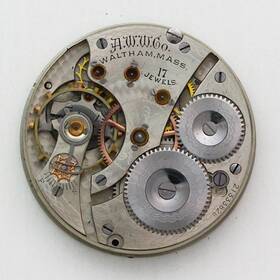
( Brand: Waltham ), ( Manufacturer Part Number: 21333828 ), ( Type: Movement ), ( Movement Type: Mechanical ), ( Compatible Model: Waltham Model 1908 ), ( Material: Nickel, Enamel ), ( Country Of Origin: United States )
Review WALTHAM Grade 625 Model Size Pocket Watch Movement And Enamel Dial Ca
The Waltham 21333828 is a meticulously crafted, high-grade pocket watch movement that embodies the timeless elegance and precision engineering of early 20th-century horology. Dating back to the 1917 era, this 16-jewel, 1908-caliber movement represents a pinnacle of mechanical sophistication, designed to deliver unparalleled accuracy and durability. The 625-hour power reserve ensures that the watch can operate for an extended period without winding, a testament to the efficiency of its lever escapement and fully jewelled pallet stones, which reduce friction and enhance performance. The movement itself is a masterpiece of brass and steel construction, featuring a finely polished and engraved plate that showcases the intricate details of its gear train, balance wheel, and hairspring all essential components that work in harmony to regulate time with remarkable consistency. The 1917 dial, though not included with the movement, would traditionally complement this piece with its classic, minimalist design, often featuring Roman numerals or Arabic figures in a bold, legible font, surrounded by a clean, uncluttered background. This movement is ideal for watchmakers and collectors seeking to restore or create a vintage-inspired pocket watch, as it combines historical authenticity with the enduring craftsmanship of the renowned Waltham Works, a brand synonymous with precision and reliability since its founding in 1857. Whether integrated into a traditional brass or leather-bound case or repurposed into a modern pocket watch, this movement promises a blend of heritage and mechanical artistry that continues to captivate enthusiasts of horology.
### Overview of the Waltham 21333828 625/1908 Pocket Watch Movement with 1917 Dial
This is a vintage pocket watch movement, specifically a **Waltham 21333828**, which is a **625-size (19.08mm) lever-set, manual-wind movement** from the early 20th century. The inclusion of a **1917 dial** suggests it is a complete or nearly complete assembly, likely from the 1910s or early 1920s. Below is a detailed analysis of its pros and cons, followed by a conclusion and recommendation.
---
### **Pros of Buying This Watch Movement**
1. **Historical Significance**
- Waltham movements are among the most prestigious and historically important in horology, dating back to the 1850s when the Waltham Watch Company pioneered mass-produced precision timepieces.
- A 1917 dial adds to its vintage appeal, making it a collectible piece for enthusiasts of antique horology.
2. **High-Quality Craftsmanship**
- Waltham movements were known for their durability and precision during their prime. The **625-size** is a standard lever-set movement, indicating it was designed for everyday wear rather than luxury.
- The **lever-set mechanism** (a safety feature to prevent accidental winding) was a hallmark of Waltham s engineering in the early 1900s.
3. **Potential for Restoration and Customization**
- If the movement is in need of repair, skilled watchmakers can restore it to working order. The **1908 model** (part of the "Old Style" Waltham series) is well-documented, making parts and restoration easier than for rarer movements.
- The dial (1917) may be original or a replacement; if it s original, it could be highly valuable depending on its condition and rarity. If not, it offers an opportunity to pair it with a more desirable dial.
4. **Resale Value for Collectors**
- Waltham movements, especially those from the early 20th century, hold value among collectors. A complete, restored, and well-documented piece could appreciate over time, particularly if it includes an original or historically significant dial.
- The **625-size** is common enough to find parts but rare enough to be sought after by vintage watch enthusiasts.
5. **Functionality and Reliability**
- If properly maintained, a Waltham movement can last decades, even centuries, with regular servicing. The **manual-wind mechanism** means it requires occasional winding but does not rely on batteries.
- The **1908 model** is known for its robustness; many examples survive today with minimal wear, especially if stored properly.
6. **Versatility in Reuse**
- The movement can be repurposed into a **pocket watch, wristwatch, or even a desk clock** with the right case and dial. The **625-size** is compatible with many vintage cases, making it adaptable for different projects.
7. **Educational Value**
- For horology enthusiasts, studying and restoring a Waltham movement provides hands-on experience with a key piece of watchmaking history. Understanding its mechanics can deepen appreciation for mechanical timekeeping.
---
### **Cons of Buying This Watch Movement**
1. **Condition and Wear**
- Vintage movements often suffer from **lubricant degradation, worn gears, or rust**, especially if stored improperly. The **1917 dial** may have scratches, fading, or missing hands, which could detract from its value.
- Without professional inspection, it s impossible to know the true extent of wear. A movement that appears "fine" on the surface may require extensive restoration.
2. **Cost of Restoration**
- Restoring a vintage Waltham movement can be expensive. A full service typically includes:- Disassembly and cleaning
- Replacement of worn or damaged parts (e.g., jewels, springs, pallets)
- Regreasing and lubrication
- Dial and hands replacement (if needed)
- Case and movement alignment
- Labor costs for a skilled watchmaker can range from **$300 to $1,000 **, depending on complexity. Parts may also need to be sourced, adding to the cost.
3. **Dial Authenticity and Condition**
- If the dial is **not original**, it may lack historical value. Even if original, **1917 dials** can vary in quality some may have faded paint, missing indices, or manufacturing defects.
- The **hands** (if included) may be worn or mismatched, requiring replacement.
4. **Case Compatibility**
- While the **625-size** is standard, finding a **matching vintage case** can be challenging. New cases exist, but they may not perfectly replicate the original aesthetic.
- If repurposing into a wristwatch, a **modern case** may be needed, which could alter the historical integrity of the piece.
5. **Time and Effort Required**
- Restoring a vintage movement is a **time-consuming process**. Even if outsourced to a professional, the buyer must coordinate with the watchmaker, source parts, and potentially wait months for completion.
- If attempting restoration oneself, it requires **horology knowledge, tools, and patience**, which may be daunting for beginners.
6. **Market Saturation**
- Waltham movements are **not rare**, meaning competition in the collector s market can drive prices down. While some examples are valuable, many are considered "common" in vintage circles.
- The **1917 dial** may not be a highly sought-after variant, depending on its design and condition.
7. **Potential for Hidden Damage**
- Without a thorough inspection, issues like **cracked plates, broken hairsprings, or worn escapements** may not be immediately obvious. These problems can render the movement unusable without significant repair work.
8. **Ethical and Conservation Concerns**
- Some collectors argue that **restoring vintage movements** can be controversial, as it may alter their original state. If the goal is **preservation over functionality**, restoration may not be desirable.
---
### **Conclusion**
Buying a **Waltham 21333828 625/1908 movement with a 1917 dial** is a decision that balances **historical appeal, potential value, and practical challenges**. This piece is ideal for:
- **Collectors** who appreciate vintage horology and are willing to invest time and money in restoration.
- **Watchmakers** seeking a project to restore and learn from.
- **Enthusiasts** who value mechanical timekeeping and are drawn to the craftsmanship of early 20th-century movements.
However, it is **not** ideal for:- **Beginners** who lack experience with vintage watch restoration.
- **Casual buyers** who want a ready-to-wear timepiece without the commitment of repair.
- **Those seeking rare or highly valuable pieces**, as Waltham movements of this era are relatively common.
The **true value** of this movement lies in its **potential** whether as a restored collectible, a functional timepiece, or a project for a skilled watchmaker. If you proceed, **prioritize a professional inspection** to assess its condition and determine the feasibility of restoration.
---
### **Recommendation**
1. **If You Are a Collector or Enthusiast:**- **Proceed with caution.** Purchase from a reputable dealer who offers **authentication and condition reports**.
- **Budget for restoration** expect at least **$500 $1,500 ** depending on the work needed.
- **Consider pairing it with an original or high-quality replacement dial** to maximize value.
- **Store it properly** if not immediately restoring it (in a dry, temperature-controlled environment).
2. **If You Are a Watchmaker or DIY Restorer:**- **Research the movement thoroughly** before buying. Consult resources like the **Waltham Watch Company archives** or horology forums for guidance.
- **Start with a less expensive example** if you re new to restoration to gain experience.
- **Document the process** restoring a Waltham is a valuable learning experience.
3. **If You Are a Casual Buyer:**- **Avoid purchasing without inspection.** Vintage movements can be deceptive in their condition.
- **Consider a modern alternative** (e.g., a high-quality vintage-style movement like a **Hamilton or Elgin**) if you want a ready-to-wear piece without restoration hassles.
4. **Final Verdict:**- **Buy it if** you are prepared for the work, have an appreciation for vintage horology, and see value in its historical and mechanical potential.
- **Avoid it if** you expect a turnkey timepiece, lack restoration experience, or are not willing to invest in its upkeep.
This movement is a **gateway to a fascinating piece of watchmaking history**, but it demands respect, care, and either expertise or a willingness to learn. For the right buyer, it can be a rewarding and valuable addition to a collection.
Details:
No guarantee of future performance. The dial is in excellent condition with no hairlines or chipping. Please look at photos carefully. This item does not include box, papers, booklet's, etc.
All visible screws and screw-set jewels are in good condition. Waltham, Mass. This movement is stem wind and set. Due to age there is no guarantee of time accuracy on antique vintage watches.
17 Jewels - 21333828. This movement comes with its original white enamel dial large black Arabic numerals, blue moon hands, a double sunk seconds register at six o'clock, and is marked Waltham USA. The movement is running great for its age.
part #: 21333828 price
- $55.00
specifications movementparpar:
- brand: Waltham
- mpn: 21333828
- type: Movement
- movement type: Mechanical
- compatible model: Waltham Model 1908
- material: Nickel, Enamel
- country of origin: United States
payments movementparpar:
- credit card: Diners-club
- wallet: Paypal
- other
returns movementparpar:
- policy: No Returns
seller movementparpar:
- rating: 100.0%
- city: Wheaton, Illinois
- # reviews: 2946
offer movementparpar:
- options: Ship-to-home
- started: February 26, 2026
- availability: In Stock
- sold: 0
- best offers: True
- quantity: 1
general movementparpar:
- condition: Pre-owned
- Parts, Tools Guides > Parts > Movements
shipping movementparpar:
- carrier: USPS
- cost: $8.00
- transit: 4-8 Days
- service: USPS Ground Advantage
- type: Fixed
- class: Standard
Waltham 21333828 Is Similar To:
- 12413469 Waltham Vintage Pocket Watch Movement (46.4% similar) Vintage Waltham pocket watch movement...(August 20th, 2018)
- 12645023 Waltham Vintage Lady Watch Movement (39.7% similar) Vintage lady Waltham watch movement. I do not know if it works or...(August 13th, 2018)
- Hmv-1146 Waltham Movement Watch Automatic Jewels Mens Works And For (26.4% similar) Movement Waltham automatic Swiss 1146,MENS movement,works and for year have crown stem self-winding dial look in good condition sale only Poe parts or repair...(October 20th, 2018)
- Waltham 0-grade Seaside-running 1891 Movement-size Watch Pocket (41.6% similar) Missing one hand, no crown, crystal or case. Up for offer is an antique Waltham pocket watch movement...(February 10th, 2015)
- 10 0s Waltham 5 Vintage 15j Watch (30.6% similar) Lot of 5 vintage 10 0s Waltham 15J watch movements, none run, a few appear to have good staffs, dial conditions vary, damasking, source for those hard find parts, parts repair steampunk craft art, sold as-is...(March 2nd, 2017)
- 10498719 Waltham Antique 15 Jewel Watch (30.8% similar) Nice clean movement, dial is very also. Estate sale find so not sure if in working condition...(February 28th, 2017)
- 10938322 Waltham Vintage Pocket Watch (35.9% similar) Has not been tested. Its ready to go. The movements move. Vintage Waltham pocket watch movement 15 jewels up for bid. The movement is in good used condition...(April 9th, 2017)
- 11030847 Pocket Parts Waltham Watch Movement Repair (40.8% similar) ...(May 31st, 2015)
- 11294690 Waltham Vintage Sub Dial (29% similar) Refer to photos, zoom feature and ask questions before buying. Please refer to photos. Great for restoration. Balance staff intact, however still needs good cleaning stops and goes attention. Even if movement works it still may need an overhaul or cleaning to optimize functionality. Photos to show ...(April 4th, 2017)
- 12170283 Waltham Size Pocket Watch Movement Model Jewels (54.4% similar) We ask that you please look at all photos and read closely before buying. Please review all photos for condition. Condition: the movement is a stem wind but not running. Communication: we ask that you please first before opening a case with. There is no crystal and a very small lite crack at 4 o'...(September 29th, 2018)
- 12439419 Waltham Circa 1890 Movement Pocket Watch (41.4% similar) Not working. Marked on rear. Co Waltham mass diameter. Waltham pocket watch movement with face dial in good condition...(February 12th, 2015)